Warehouse space in Saudi Arabia behaves like airline seats: identical square metres cost wildly different amounts depending on when you ask, and the people who plan ahead fly for a fraction of what the desperate pay. The Kingdom’s retail year is not a smooth curve — it is a series of surges built around Ramadan, the two Eids, Hajj, the school year, and the November sales season. Retailers who map their storage commitments to that rhythm hold their margins. Those who book space when they suddenly need it fund everyone else’s discount.
Here is how the year actually unfolds from a warehousing perspective, and when the smart money moves at each point. Treat the dates below as anchors for your own planning wall, adjusted each year as the lunar calendar walks the seasons forward.
Ninety days out: the pre-Ramadan build begins
Ramadan is the largest consumption event in the Saudi calendar, and it is fought and won in the quarter before it starts. Grocery volumes climb sharply as households stock up for iftar and suhoor, and the categories that spike hardest — meats, poultry, pastries, ready-to-cook lines, ice cream for the post-fast hours — are overwhelmingly frozen.
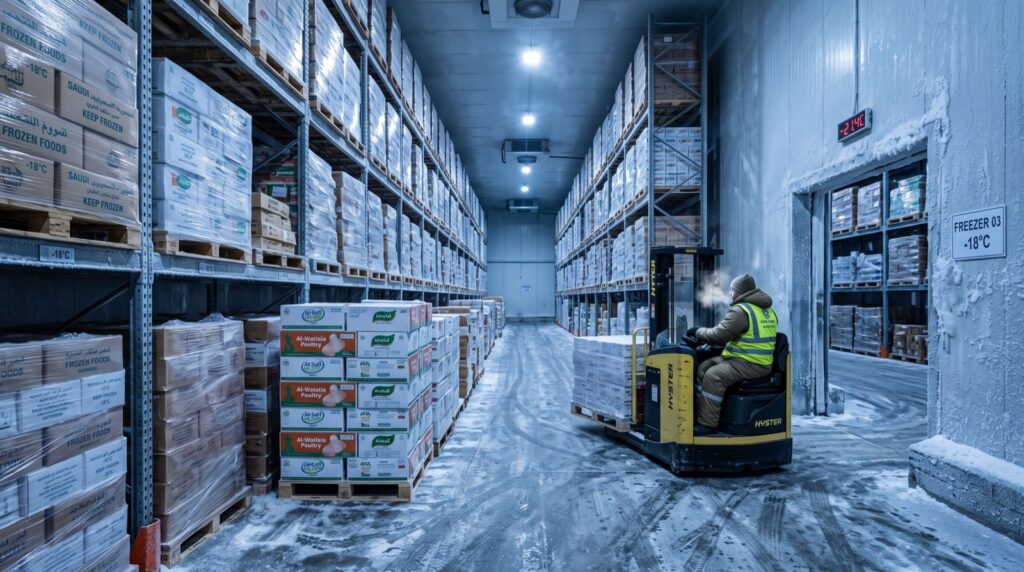
Capacity in professional Frozen Storage facilities tightens earlier every year, because importers have learned to land Ramadan stock two to three months ahead while shipping rates and port congestion are still manageable. By the time the crescent is a month away, freezer space in the main logistics hubs is functionally sold out, and latecomers are trucking product between cities just to find a chamber that will take it. The planning rule is blunt: if your Ramadan freezer commitments are not signed ninety days out, you are already negotiating from weakness.
Ramadan itself: velocity, not volume
Once the month begins, the warehousing challenge flips. The build is done; now the game is throughput. Delivery windows compress around iftar, night-shift picking becomes the norm, and replenishment cycles that ran weekly start running daily. The facilities that shine here are the ones staffed and lit for round-the-clock operation — a detail worth checking in any contract long before you need it honoured. Eid al-Fitr then empties shelves one final time and hands you a new problem: leftover seasonal stock that must be cleared or carried at full storage cost.
The Hajj window: a squeeze that surprises newcomers
Two months after Ramadan, Hajj concentrates millions of additional consumers into the western region for a matter of weeks. Caterers, hotels, and institutional feeders around Makkah draw enormous volumes through Jeddah’s logistics corridor, and transport capacity gets diverted toward pilgrim-related demand. Businesses outside the food sector feel this indirectly: trucks are scarcer, west-coast warehousing runs hot, and anything non-urgent is better scheduled around the window rather than through it. Firms that pre-position their western-region stock before the season keep selling while competitors wait on freight.
Late summer: the quiet reset and the school-year ramp
The weeks after Hajj are the closest thing the Saudi logistics year offers to a lull, which makes them the right moment for the unglamorous work: stock counts, facility maintenance windows, and renegotiating agreements while operators actually have time to talk. It is also when back-to-school inventory starts landing — stationery, uniforms, electronics, and household goods that need clean, dry space rather than refrigeration.
This is the season when flexible Ambient Storage in Saudi Arabia proves its worth. Shelf-stable and general merchandise makes up the bulk of most retailers’ seasonal builds, and ambient space is where scalability is easiest to buy — provided it is genuine warehouse-grade space with dust control and ventilation, not a bare shed radiating summer heat into your cartons. Booking expandable ambient capacity in this window typically costs meaningfully less than chasing the same space in October.
November and the year-end rush
White Friday, 11.11, and year-end promotions have turned the fourth quarter into the Kingdom’s e-commerce peak. Fulfilment operations need pick-face space, returns processing room, and short-term overflow — often triple their baseline footprint for six weeks. The retailers who survive it comfortably arranged burst capacity in September; the ones who did not spend November stacking cartons in office corridors.
Returns deserve their own line in the plan. Peak-season e-commerce in the Kingdom can send back a meaningful share of what ships, and every returned parcel needs somewhere to be inspected, regraded, and restocked. A facility that can wall off a temporary returns bay in December is worth more than its rate card suggests.
The lead-time rules worth pinning to the wall
Across all of these seasons, a few booking disciplines separate planned operations from expensive improvisation:
- Sign frozen and chilled commitments about ninety days before Ramadan; cold capacity always sells out first.
- Lock transport for the Hajj window at least six weeks ahead, even for non-food cargo.
- Arrange fourth-quarter overflow space by the end of September, with a defined exit date so you are not paying for empty racks in January.
- Negotiate renewals in the post-Hajj lull, when operators have vacancy on their minds and flexibility to offer.
- Keep roughly ten to fifteen percent of your total footprint on short, flexible terms as a shock absorber for forecast misses.
Pay for flexibility on purpose, not by accident
Notice the pattern in those rules: the goal is not to book the maximum space at the minimum rate. It is to hold a core of committed capacity sized to your baseline, plus deliberately purchased flexibility for the surges. Flexible space carries a premium per square metre, but it is a premium you chose — unlike emergency space in the second week of Sha’ban, which is a premium the market chose for you.
The same discipline applies to the money side of seasonal stock. Inventory builds tie up serious working capital months before the revenue arrives, and companies that track that cash cycle closely — with the same rigour that reputable service experts recommend for managing any budget — enter each peak season funded rather than frantic.
Saudi Arabia’s retail calendar is unusually predictable; the dates shift with the lunar year, but the sequence never changes. That predictability is a gift to any business willing to plan against it. Put the surges on the wall, work backwards ninety days from each one, and let your competitors be the ones paying spot rates for the last freezer chamber in Jeddah.