
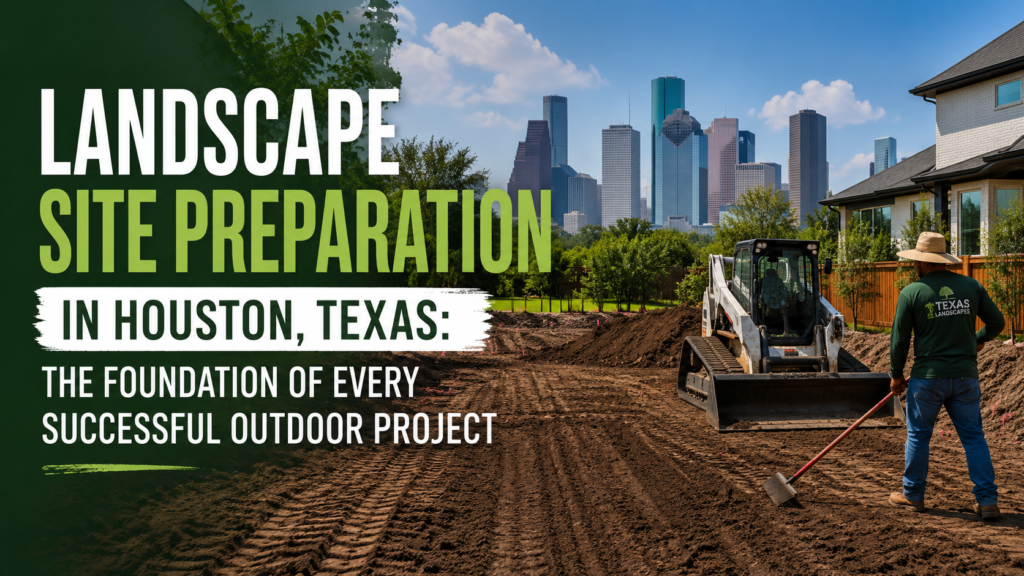
In Houston, landscape site preparation is a service shaped profoundly by the city’s unique environmental conditions its subtropical climate, expansive clay soils, flat topography, and persistent flooding challenges create a preparation environment unlike anywhere else in the country. Whether the project is a new residential landscape installation, a commercial outdoor space development, or the revitalization of a vacant urban lot, the quality of site preparation determines the long-term success or failure of everything installed above it. Understanding what landscape site preparation involves in Houston helps property owners, developers, and landscape professionals make decisions that lead to durable, functional outdoor environments.
What Landscape Site Preparation Encompasses
Landscape Site Preparation Houston is not a single task but a coordinated sequence of operations that transforms raw, disturbed, or overgrown land into a stable, properly graded, and drainage-ready surface. In Houston, the comprehensive scope of this work includes:
- Vegetation and debris clearing: Removal of existing vegetation, stumps, surface debris, and materials that would interfere with grading or new plantings.
- Grubbing: Extraction of root systems and sub-surface organic material that, if left in place, would decompose and cause settling in the new landscape.
- Rough grading: Initial reshaping of the terrain to approximate final contours and drainage slopes.
- Soil assessment and amendment: Evaluating existing soil conditions and incorporating amendments to improve drainage, structure, or fertility where needed.
- Drainage infrastructure: Installing drainage systems French drains, catch basins, surface swales, pop-up emitters appropriate to the site’s water management needs.
- Fine grading: Precision shaping of the finished surface to specified grades.
- Topsoil placement: Redistributing quality topsoil to support vegetation establishment.
- Erosion control: Applying seed, sod, erosion blankets, or other measures to stabilize disturbed soil until permanent vegetation establishes.
Houston’s Clay Soils: The Central Challenge
Houston’s landscape site preparation is dominated by the challenges of its heavy, expansive clay soils. The Houston and Beaumont clay series that underlie most of the metropolitan area are among the most challenging foundation and landscaping soils in the United States. These clays:
- Shrink significantly during summer drought, creating visible cracks in the soil surface and under structures.
- Expand substantially when wet, exerting pressure against foundations and causing frost heave-like movement in landscaped areas.
- Have very low permeability when dense, causing water to pond on the surface after rainfall rather than infiltrating.
- Create drainage challenges that require engineered solutions rather than relying on natural soil drainage.
Addressing these soil conditions during landscape site preparation is not optional in Houston it is the defining technical challenge of the work. Incorporating organic matter to improve soil structure, installing drainage infrastructure to manage surface and sub-surface water, and designing landscape grades that move water efficiently to drainage outlets are all essential responses to Houston’s clay conditions.
Drainage: The Most Critical Design Element
In Houston’s flat landscape, where natural drainage gradients are often minimal and rainfall intensity can be extreme, drainage is the most important design consideration in landscape site preparation. Houston receives approximately 49 inches of rainfall annually, with significant rainfall often arriving in intense events that challenge any stormwater management system.
Landscape site preparation in Houston must establish:
- Positive drainage away from structures: The finished grade must slope away from any building’s foundation at a minimum of 6 inches over the first 10 feet of horizontal distance. Without this positive slope, water accumulates against foundations and initiates the moisture cycling that is the primary cause of Houston’s notorious foundation movement problems.
- Surface drainage to appropriate outlets: Water that leaves the immediate building perimeter must be directed to the street, an alley, a drainage channel, or an appropriate stormwater management feature. Drainage that simply moves water from one part of a property to another without a proper outlet creates problems for neighboring properties.
- Sub-surface drainage where needed: In areas of Houston where the water table is near the surface or where clay soils create perched water conditions, French drains, perforated pipe systems, and drainage stone beds are needed beneath the landscape surface to intercept groundwater before it affects foundations or creates saturated planting areas.
Topsoil Quality and Amendment in Houston
Houston’s native clay soils are poor growing mediums for most landscape plants. They compact easily, drain slowly, and when dry become hard enough to prevent root penetration. Successful landscape establishment in Houston requires either importing quality topsoil or amending existing soils to create more favorable growing conditions.
Imported topsoil used in Houston landscape site preparation should be a sandy loam or loam with good drainage characteristics, pH in the 6.0 to 7.0 range, and adequate organic matter content. Quality topsoil placed to a minimum depth of 4 to 6 inches for turf and 8 to 12 inches for planting beds provides the growing medium that landscape installations need to establish successfully and thrive in Houston’s subtropical climate.
Texas 811 and Utility Awareness
Before any landscape site preparation involving ground disturbance in Houston, Texas 811 must be called at least two business days before digging begins. This is required by Texas law for all excavation activities, regardless of scale. In Houston’s densely developed urban environment, underground utilities gas lines, water mains, electrical conduit, telecommunications, and irrigation systems are present throughout the landscape. Striking an underground utility during preparation can cause serious injuries, service disruptions, and significant liability.
Conclusion
Landscape site preparation in Houston requires a thorough understanding of the city’s challenging clay soils, its demanding subtropical climate, and its complex drainage environment. The work that happens below the surface grading, drainage infrastructure, soil preparation determines the health and longevity of every element of the finished landscape above it. Property owners and developers who invest in thorough, properly executed site preparation set the stage for outdoor environments that function well, drain correctly, and remain beautiful through Houston’s demanding seasons.